
Virtual World Apps in 2026: Second Life, IMVU, Highrise and the Social-Map Alternative
The main virtual world apps compared (Second Life, IMVU, Highrise, Avakin Life, Rec Room, VRChat, ZEPETO), what they are good at, and when a social map of your real city is the better fit.
On this page
A virtual world app lets you be an avatar in a shared, always-on place: rooms, cities or whole planets that exist only in the app. In 2026 the category spans twenty-year-old PC worlds and phone-first apps aimed at teenagers. This guide compares the main ones, then explains a newer alternative, the social map, where the "world" is the real city you are standing in.
Disclosure: we make iS Gather, the social map at the end of this article. The virtual worlds are described from their own public pages, linked in each section, as of November 2026.
What counts as a virtual world app
For this guide a virtual world app has three things: a persistent shared space, an avatar that represents you in it, and other people in real time. That excludes avatar makers with no shared space and single-player games. It includes worlds that are mostly social (IMVU, Highrise), worlds that are mostly games (Rec Room) and open platforms that are both (Second Life, VRChat).
The main virtual world apps in 2026
Second Life
Second Life opened in 2003 and is still the reference point: user-built regions, an exchangeable currency, live music, education and long-running communities. It is primarily a PC experience with a mobile client. Depth is the draw; a steep first hour is the cost.
IMVU
IMVU (2004) is a 3D avatar chat world organised around rooms and an enormous catalogue of member-made items. It is listed as 17+ on the App Store and is aimed at adults, according to Common Sense Media's review. We compare it with our own app in iS Gather vs IMVU.
Highrise
Highrise is a phone-first world with stylised avatars, rooms, crews, events and a creator economy. Its own 2026 round-up of mobile virtual worlds is a good survey of the mobile end of the category.
Avakin Life
Avakin Life is a 3D life simulation on phones and desktop: an apartment to decorate, outfits, venues and parties. It is the most IMVU-like of the mobile worlds.
Rec Room and VRChat
Rec Room is a cross-platform social game space (VR, console, PC, phone) where people play and build games together. VRChat is an open platform of user-made worlds and custom avatars, strongest on VR and PC. Both are free with cosmetics sold in-app.
ZEPETO
ZEPETO combines a stylised avatar with a photo-and-clip feed, items and brand collaborations, and is popular in East Asia. It is as much a content app as a world.
Virtual world apps compared
| App | Since | Main platform | What you do | Economy |
|---|---|---|---|---|
| Second Life | 2003 | PC | Build, explore, events, communities | Yes, exchangeable currency |
| IMVU | 2004 | Phone, desktop | Dress avatar, chat in rooms | Yes, credits |
| Highrise | 2010s | Phone | Rooms, crews, events | Yes |
| Avakin Life | 2013 | Phone, desktop | Apartment, outfits, venues | Yes |
| Rec Room | 2016 | VR, console, PC, phone | Play and build games | Cosmetics |
| VRChat | 2014 (public 2017) | VR, PC | User-made worlds, custom avatars | Cosmetics, creator items |
| ZEPETO | 2018 | Phone | Avatar feed, items, worlds | Yes |
Launch years are from each company's public history; where a product had a long beta we give the year most sources use.
What virtual worlds are good at
A virtual world gives you a place to be when there is nobody around you, a way to express yourself that has nothing to do with your face or your postcode, and communities organised by interest rather than geography. For a hobbyist, a creator who sells items, or someone in a small town, that is the whole point.
What they are not good at
Nothing in a virtual world is near you. The friend you made in a room is in another country more often than not, and the world only exists while the app is open. That is fine if a virtual place is what you want. It is a limitation if what you want is to meet people you could have a coffee with on Saturday.
The alternative: a social map
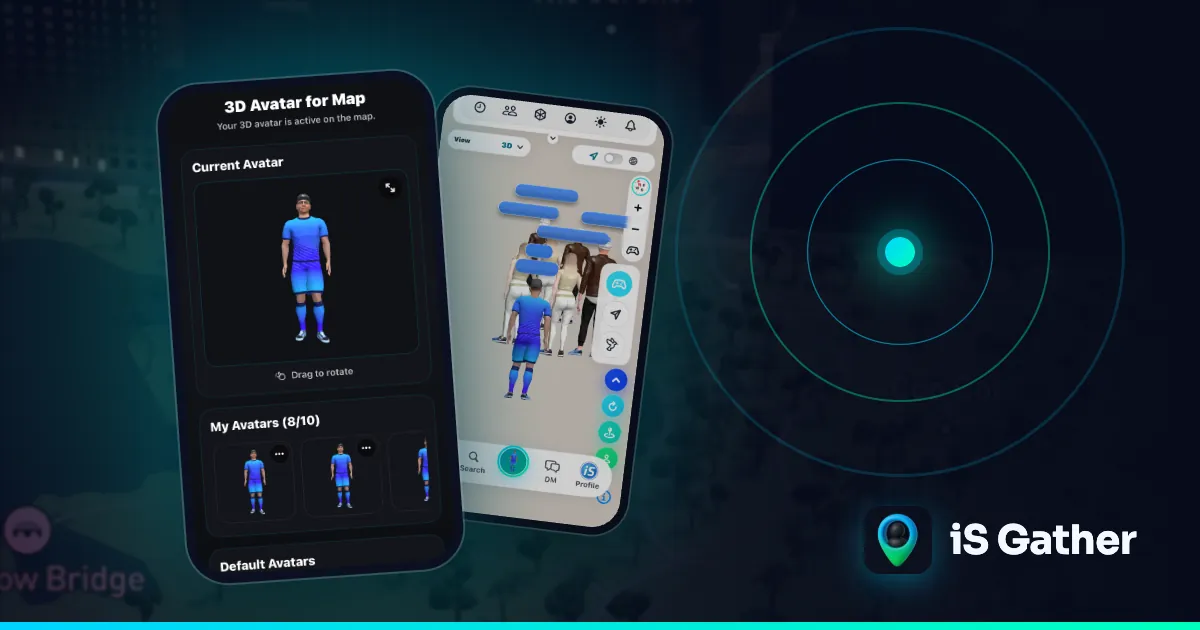
A social map keeps the avatar and swaps the virtual world for the real one. On iS Gather you make a realistic 3D avatar from a photo, and it appears on a live map at your real position when you set yourself to Public. The other avatars on the map are members nearby now. You can send a one-tap ice breaker, message, and watch short videos by people in your city. Set Private and you disappear from the map while everything else still works.
| Virtual world | Social map (iS Gather) | |
|---|---|---|
| The place | Built in the app | Your real city |
| The people | Anywhere in the world | Physically nearby |
| Avatar | Catalogue, stylised | Realistic, from a photo |
| Economy | Usually an item shop | None |
| Best for | Hobbies, expression, global communities | Meeting people you can actually meet |
| Age | Varies, often 17+ | 16+ |
The honest limitation runs the other way: a social map is only as lively as the number of members around you. iS Gather launched in 2026, with most members in the United States and Japan, and a quiet map in a small town is possible. Our map-based social app guide explains how the map works and what you see on it.
How to decide
If you want a place, choose a virtual world and pick by platform and community. If you want people nearby, choose a social map. If you are not sure, the two are not exclusive: plenty of people keep a virtual world for the evening and a map app for the weekend. The list of IMVU alternatives sorts the virtual worlds by the job each does best.
Frequently asked questions
What is the best virtual world app on a phone?
For rooms and fashion, Highrise and Avakin Life; for content, ZEPETO; for games with friends, Rec Room. If you want the people in the app to be near you, iS Gather is a social map rather than a virtual world.
Is Second Life still active in 2026?
Yes. Second Life has run continuously since 2003 and remains the largest open virtual world, mainly on PC.
Are virtual world apps safe for teenagers?
Ratings vary by app and store, and several are listed 17+. Read the current store rating and the app's safety page. iS Gather is 16+ and has block and report tools.
What is the difference between a virtual world and a social map?
A virtual world is a place built inside the app with people from anywhere. A social map is a live map of your real surroundings with people who are nearby. Both can use 3D avatars.
Do I have to share my location on iS Gather?
No. The Private setting keeps you off the map entirely; Friends shows you only to people you added; Public shows your avatar to members nearby.
Where to go next
Read what a 3D avatar social network is, open the live map, or see who is nearby in your city.
- #virtual world app
- #virtual world apps 2026
- #avatar apps
- #social map
- #3D avatar social network
Keep reading
- Comparison
IMVU Alternatives in 2026: 7 Avatar Apps Sorted by What They Do Best
Seven IMVU alternatives compared by where the avatar lives, how you meet people, platforms and in-app economy: iS Gather, Highrise, Avakin Life, Second Life, Rec Room, VRChat and ZEPETO.
- Comparison
iS Gather vs IMVU: 3D Avatar Social Apps Compared (2026)
IMVU is a virtual world of avatar chat rooms; iS Gather puts a 3D avatar on a live map of your real city. A dated, sourced comparison of the two models, with a side-by-side table.
 3D avatars
What Is a 3D Avatar Social Network? Explained (2026)
What a 3D avatar social network is, why people choose avatars over photos, what to look for in an app, and how iS Gather uses 3D avatars on a live map to meet people nearby.